FAQ - Believarexic
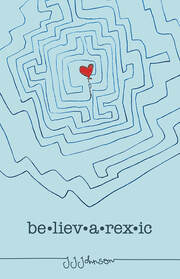
What's the story behind Believarexic?
My editor and I were kicking around ideas for my next novel. I told her I still had all my old journals and letters from when I stayed at an in-patient Eating Disorder Unit (EDU), and I could use them to write a book. I don't think either of us had any idea what it would lead to, or how difficult the process would be.
My editor and I were kicking around ideas for my next novel. I told her I still had all my old journals and letters from when I stayed at an in-patient Eating Disorder Unit (EDU), and I could use them to write a book. I don't think either of us had any idea what it would lead to, or how difficult the process would be.
The novel is very personal, with your relationships with friends and family described in detail. How did they feel about that?
So, yeah, I used the real names for my mother, father, brother, and my best friend, Kelly—with their permission. (All other names were changed.) Kelly was easy; she’s ready for fame. But my family—writing about them was intense. For the book to feel authentic, I needed to be honest and real, and not hold anything back. But doing that can be brutal. I didn’t want to hurt them; I’ve already put them through a lot! But my parents read every draft, and have been unwaveringly supportive and good-humored. Their generosity is deeply humbling.
So, yeah, I used the real names for my mother, father, brother, and my best friend, Kelly—with their permission. (All other names were changed.) Kelly was easy; she’s ready for fame. But my family—writing about them was intense. For the book to feel authentic, I needed to be honest and real, and not hold anything back. But doing that can be brutal. I didn’t want to hurt them; I’ve already put them through a lot! But my parents read every draft, and have been unwaveringly supportive and good-humored. Their generosity is deeply humbling.
There are plenty of books about eating disorders. Why write another one?
- The title itself points to the fact that eating disorders are about more than disordered eating. I think a lot of existing novels don't convey that message. To me, eating disorders are about belief in ourselves and our connections to others.
- Believarexic is 100 percent focused on recovery. I've seen a lot of novels and memoirs that are much more focused on the illness stage of the disorder, which basically turns them into how-to manuals for eating disorders. I was very, very careful not to do that with Believarexic. I never mention specific weights--whether diet "target" weights or maintenance ranges--nor do I ever discuss tricks or strategies for purging or restricting food.
- I think an inpatient setting is just a very fascinating world.
- The 1980s! Who doesn't love the 80s?
Did you recover? Do you still struggle with your eating disorder?
I fully recovered from bulimarexia, and I consider myself 99.7 percent recovered from believarexia. That tiny 0.03 percent represents the occasional day when I doubt or feel bad about myself. Like everyone, I'm perfectly imperfect. I did have some e.d. relapses, which you can read more about on the Believarexic website.
I fully recovered from bulimarexia, and I consider myself 99.7 percent recovered from believarexia. That tiny 0.03 percent represents the occasional day when I doubt or feel bad about myself. Like everyone, I'm perfectly imperfect. I did have some e.d. relapses, which you can read more about on the Believarexic website.
Where can I read more of your thoughts about Believarexic?
Here's an interview I did with Bull Spec. And here's one on Peachtree's blog.
Here's a time-travel letter on Dear Teen Me.
I wrote a piece for librarians, parents, and carers in School Library Journal.
And Believarexic has its very own website, with lots of goodies and information, here.
Here's an interview I did with Bull Spec. And here's one on Peachtree's blog.
Here's a time-travel letter on Dear Teen Me.
I wrote a piece for librarians, parents, and carers in School Library Journal.
And Believarexic has its very own website, with lots of goodies and information, here.
I read Believarexic and I think I have an eating disorder. What should I do?
PLEASE. GET. HELP.
I’m not kidding.
If you have even just a glimmer of a spark of a thought that you maybe might have an eating disorder, then your eating is disordered enough to need help. The end. Full stop. No arguments.
You may think your eating disorder is not “bad enough” for treatment. Or, you know you have an e.d., but you think you need it as a core identity. Or you may think there’s no hope, you’re too far gone. Or you think “ana” or “mia” are your friends. They are NOT your friends. They are conniving, backstabbing bitches.
No, no, no no no. There is SUCH A BETTER LIFE FOR YOU.
Recovery is possible. It’s not easy, but it’s worth it. I promise.
Say something to someone.
Write a note.
Send an email.
Make a phone call.
Try a guidance counselor, minister or rabbi, teacher, parent, guardian, 12-Step meeting, or eating disorder hotline.
AND DON’T YOU DARE STOP REACHING OUT UNTIL YOU GET THE HELP YOU NEED.
The National Eating Disorders Association (NEDA)
has a free online chat Helpline at http://www.nationaleatingdisorders.org/find-help-support and a free, confidential phone Helpline: 1-800-931-2237. They can connect you to local help, as well.
Eating Disorders Anonymous (EDA)
is a 12-Step program with meetings online, over the phone, and/or in your town. Please go to http://www.eatingdisordersanonymous.org/meetings.html for information. The only requirement for EDA membership is a desire to recover from an eating disorder. Meetings are always free. (These meetings were invaluable to me in the early days of my recovery.)
HelpGuide.org
has trustworthy information about eating disorders and an online screening tool for eating disorders. It also has excellent advice about HOW to ask for help, and how to start helping yourself in the meantime.
I KNOW YOU THINK YOU CAN’T OR SHOULDN’T ASK FOR HELP. BUT YOU CAN. AND YOU SHOULD.
I believe in you. I think you’re smart and awesome.
I want to see you shine again.
I want you to be able to think about something other than food and weight.
I want your life to expand in good directions.
What are you waiting for? Take that leap of faith. Trust that you’ll grow wings when you do.
I’ll be right here cheering for you.
Xoxo,
J. J.
PLEASE. GET. HELP.
I’m not kidding.
If you have even just a glimmer of a spark of a thought that you maybe might have an eating disorder, then your eating is disordered enough to need help. The end. Full stop. No arguments.
You may think your eating disorder is not “bad enough” for treatment. Or, you know you have an e.d., but you think you need it as a core identity. Or you may think there’s no hope, you’re too far gone. Or you think “ana” or “mia” are your friends. They are NOT your friends. They are conniving, backstabbing bitches.
No, no, no no no. There is SUCH A BETTER LIFE FOR YOU.
Recovery is possible. It’s not easy, but it’s worth it. I promise.
Say something to someone.
Write a note.
Send an email.
Make a phone call.
Try a guidance counselor, minister or rabbi, teacher, parent, guardian, 12-Step meeting, or eating disorder hotline.
AND DON’T YOU DARE STOP REACHING OUT UNTIL YOU GET THE HELP YOU NEED.
The National Eating Disorders Association (NEDA)
has a free online chat Helpline at http://www.nationaleatingdisorders.org/find-help-support and a free, confidential phone Helpline: 1-800-931-2237. They can connect you to local help, as well.
Eating Disorders Anonymous (EDA)
is a 12-Step program with meetings online, over the phone, and/or in your town. Please go to http://www.eatingdisordersanonymous.org/meetings.html for information. The only requirement for EDA membership is a desire to recover from an eating disorder. Meetings are always free. (These meetings were invaluable to me in the early days of my recovery.)
HelpGuide.org
has trustworthy information about eating disorders and an online screening tool for eating disorders. It also has excellent advice about HOW to ask for help, and how to start helping yourself in the meantime.
I KNOW YOU THINK YOU CAN’T OR SHOULDN’T ASK FOR HELP. BUT YOU CAN. AND YOU SHOULD.
I believe in you. I think you’re smart and awesome.
I want to see you shine again.
I want you to be able to think about something other than food and weight.
I want your life to expand in good directions.
What are you waiting for? Take that leap of faith. Trust that you’ll grow wings when you do.
I’ll be right here cheering for you.
Xoxo,
J. J.